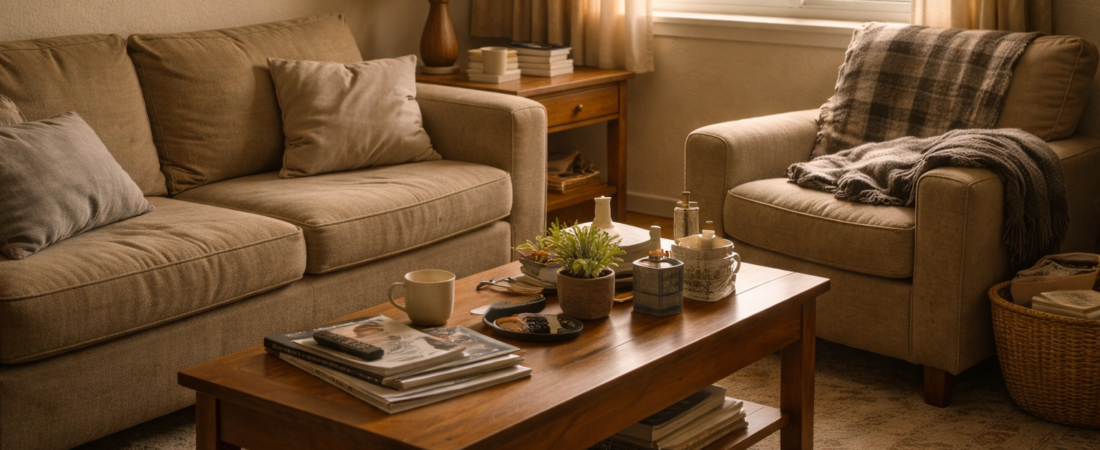
A home can feel cluttered even when there are relatively few belongings inside it. This experience is common in everyday living spaces and often has less to do with how many items exist and more to do with how those items interact with the space.
Clutter is not always about quantity. In many homes, the feeling of clutter comes from how objects move through a space, where they tend to accumulate, and how easily the space supports everyday routines.
Understanding why a space feels cluttered is often the first step toward making it easier to use.
Clutter Is Often About Movement, Not Possessions
Most homes contain a manageable number of everyday items. However, those items move constantly throughout the day.
Mail arrives and lands on a counter.
Shoes are removed near a doorway.
Laundry travels from bedroom to machine to drying space.
When a home does not have clear pathways or resting places for these movements, objects pause wherever there is open surface space. Over time, these small pauses create clusters of items that make a room feel crowded.
In many cases, the home itself is not overfilled. The space simply does not guide where everyday items naturally belong during daily routines.
Visual Surfaces Fill Faster Than Storage
Human attention is naturally drawn to open surfaces such as:
Kitchen counters
Dining tables
Coffee tables
Entry benches
Bathroom vanities
These surfaces are convenient and easy to reach, so they often become temporary holding areas. Even a few objects placed on multiple surfaces can create the impression that a room is full.
Storage spaces such as cupboards, drawers, and shelves may still have room available, but if they are less convenient than a nearby surface, items rarely return there during the day.
As a result, the visible parts of a home become crowded while hidden storage remains underused.
Daily Life Produces “Pause Points”
Most homes develop what can be thought of as pause points. These are places where objects naturally stop during everyday activity.
Common pause points include:
Entry tables where keys and bags land
Kitchen counters where mail or groceries rest
Bedroom chairs that hold clothing
Bathroom counters used for daily items
Pause points are not necessarily a problem. In fact, they are often a normal part of how homes function.
However, when pause points grow larger or more frequent, they can create the sense that clutter is spreading even when the overall number of belongings remains the same.
Rooms Designed for One Purpose Often Carry Many
Many homes were designed with simple room functions in mind:
Living rooms for sitting
Dining rooms for meals
Bedrooms for sleeping
In modern daily life, these rooms often serve several purposes at once.
A dining table may become a workspace.
A living room may hold hobby materials or paperwork.
A bedroom may store extra laundry or seasonal items.
When multiple activities share the same space, objects associated with each activity begin to overlap. Even small overlaps can create the sense that the room is crowded or disorganized.
Visual Density Influences How Spaces Feel
A room does not need many objects to feel visually dense.
Several small items placed close together can create the same feeling as a larger quantity of belongings spread out more evenly. This is especially noticeable when objects vary in shape, color, or height.
For example:
Stacks of mail
Groups of small kitchen items
Collections of chargers or cables
Multiple decorative pieces
These clusters increase visual complexity, which can make a room feel cluttered even when the actual number of items is modest.
Storage That Is Difficult to Access Often Goes Unused
In many homes, storage exists but is inconvenient to use during everyday routines.
Examples include:
High shelves
Deep cupboards
Closets that require rearranging other items
Containers that must be opened or unpacked
When storage requires extra steps, everyday items are more likely to remain on visible surfaces.
Over time, the difference between easy access and difficult access quietly shapes where objects stay.
Clutter Is Often Temporary, But It Feels Permanent
Another reason homes can feel cluttered is that temporary items tend to remain visible longer than expected.
Examples include:
Packages waiting to be opened
Items waiting to be returned
Laundry waiting to be folded
Mail waiting to be sorted
Each individual item may only remain in the space briefly. However, because new temporary items continue to arrive, the space can appear continuously cluttered.
This creates the impression that clutter is permanent, even though the objects themselves are constantly changing.
Flow Matters More Than Storage Capacity
In many homes, improving how items move through the space has a greater effect than simply adding more storage.
When everyday objects have natural stopping points that align with daily routines, they tend to settle into those locations more consistently.
Small adjustments can make a noticeable difference, such as:
A tray near the entry for keys
A basket for incoming mail
A chair designated for worn clothing
A container for daily-use kitchen items
These changes do not necessarily reduce the number of possessions in a home. Instead, they guide where those possessions pause during daily life.
This approach focuses on flow rather than reduction.
Clutter Often Reflects Normal Living
It is also useful to remember that some degree of visible activity is normal in a home.
Shoes near a doorway, a book on a table, or a jacket on a chair can simply reflect the fact that the space is being used.
The goal of household organization is not to eliminate every visible item. Instead, it is to make everyday spaces easier to use and easier to reset when needed.
Understanding how objects move through a home helps reduce the feeling of clutter without requiring constant effort.
For a broader explanation of how everyday spaces work together, see Household Organisation and Flow: Keeping Spaces Easy to Use on EverydayHomeSystems.com.